
Managing the Service Department through High Oil Prices

The Iran war disrupted the oil market and it could hurt your service department.
Related to service specifically, full synthetic motor oil is on “allocation” from multiple OEMs, meaning some dealers can’t get as much as they want. Bulk full synthetic motor oil received price increases around 30-35% based on 10+ interviews we’ve done with dealers and aftermarket shops in summer 2026.
We’ll cover three areas you should examine so you’re optimally positioned in this market. First, the competitive dynamics of the auto service market put you at higher risk. Second, the programs you offer may need to change. Third, you must be prepared when your customers ask you what’s going on.
Competitive Dynamics:
It’s tempting to think that if motor oil prices go up 30% for you, they go up 30% for everyone else, and thus, nothing changes. However, this may not happen as you’d expect. The reason is that the dealer channel’s margins are typically higher than the aftermarket’s margins. We’ve done the math on this.
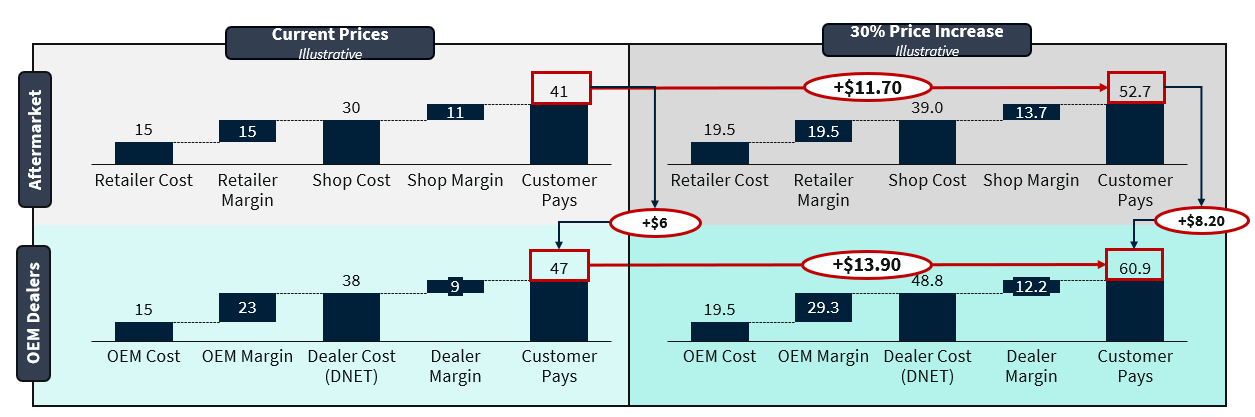
In early 2026, your OEM and the aftermarket both bought oil from their supplier at $15 for 6 quarts of oil.
The aftermarket you compete with sets a lower margin on their oil before it gets to the lube shop – theirs is 50% versus your OEM who takes 60%.
The lube shop might take another 27% on their own (the margin between the shop’s cost and the customer price). Your margin is only 19% here! That should bring you right back in line…
Unfortunately not. Assuming the same $15 cost, the aftermarket customer price for that oil before the war is $41. Yours is $47. Luckily you’re only $6 higher – not too bad. That’s the price of a good cup of coffee like they’d get at your dealership.
However, after a 30% price increase in input costs, that $6 customer price gap spreads to $8.20. Now you’re over the coffee threshold. Customers may look for other options.
This graphic makes it clear. Note the margin percentages do not change as costs increase:
Reconsider your margin on oil changes. Don’t put service retention at risk because you didn’t change your margins a few points.
Programs you Offer:
Many dealers offer oil change packages. Here’s a popular offer: 5 oil changes for ~$55 each.
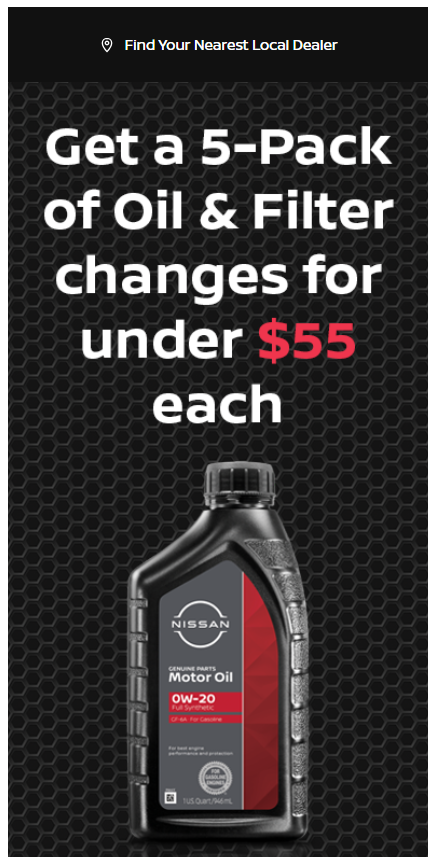
When oil doesn’t change in price frequently, these programs are easy to value and forecast.
If you’re offering such a program in 2026 and you (not the OEM) are on the hook for the costs, be extremely cautious. You may end up selling oil changes for $55 in 2026 that cost you more than $55 in the future.
These programs also require you to have the oil to do the oil change. If you turn away a customer who paid $250 for five oil changes and now they can’t use their coupon, you’ve got a serious problem.
You don’t need to scrap your oil change package deals, just be cautious when you price them and consider shortening the term if you want to limit your risk.
Your Customers:
Our company founder David Carlisle told me “10% of people are always going to love you. 10% of people are always going to hate you. The 80% of people in the middle are who you need to reach.”
Any time you end up close to a political topic (like the Iran war), be careful. You’re about to tell a customer that the oil change they paid $80 for six months ago costs $100 now. Here’s what each customer will say:
- The 10% who loves you? They won’t notice/won’t care and will pay you.
- The 10% who hate you? They’re always a bit mad and this is a good excuse to be furious. Your goal here is to make sure they don’t post on social media or tell their friends how mad they are.
- The 80% in the middle? They need a clear, coherent, factual response when they ask you about the oil change cost.
Here’s how to deliver that factual response.
- Benchmark yourselves against the other oil change providers in the area. Write down their prices and keep checking monthly.
- If the customer asks about the cost increase, tell them “Everyone has seen costs go up. We track prices in the area and everyone is up around X%. We’re doing the best we can to keep costs down for you.” Stick to the facts.
- Do not mention the cause of the cost increase. You don’t want a political discussion at the service advisor’s desk. It doesn’t matter why the prices are up. If the customer wants to have that discussion, stick to the facts. Crude prices are higher. Your costs are higher. Your competitors increased price like you did.
Communicate this to service advisors, technicians, and parts. Your goal is to share facts and avoid opinions, and the entire team must be on the same page. You don’t want to be on Tiktok because your staff shared an opinion about oil prices that the customer didn’t like.
The Bottom Line:
These high oil prices are tougher for you than for the aftermarket because of the way OEM and dealer margins work – don’t be surprised if the price gap increases. Work to keep it down. Don’t sell something that will come back to hurt you in a year or two if prices remain high or get worse. And ensure you don’t get bad press – stick to the facts when asked why this is happening.


authored by
Nate Chenenko
Nate is a Principal at Ducker Carlisle where he leads emerging trends research. Nate holds a bachelor’s degree in political science and economics from the University of Rochester. Nate has 14 years of experience in motor vehicle aftersales and leads projects primarily focused on parts logistics, service, and finished vehicle logistics.
Get Curated Insights
Content worth the click
Related Articles


