
The Problem With Car Ads Isn't AI. It's Slop.

AI has made automotive marketing faster, cheaper and infinite. Has it made any of it better?
I came across a post from Porsche’s Newsroom this morning that stopped me scrolling. The image certainly helped: a Porsche 906 silhouetted against a solar eclipse is hardly difficult to look at. No, it was the caption that caught me: ‘No filters. No AI. No second chances.’
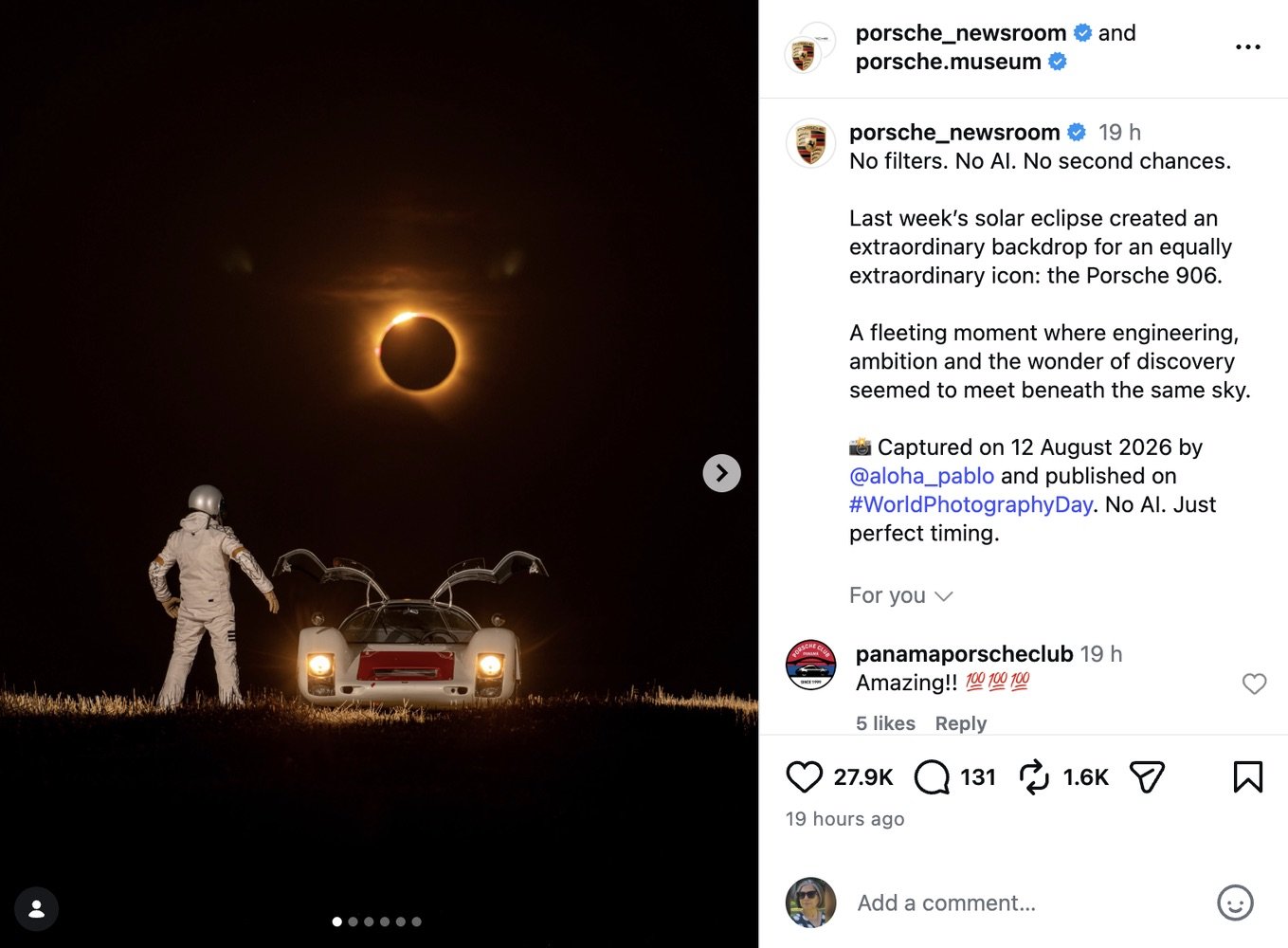
Credit: Porsche Newsroom / aloha_pablo
The photograph had been captured during the 12 August 2026 solar eclipse. Porsche finished the post with: ‘No AI. Just perfect timing’. We’ve reached a point where one of the world’s biggest car brands thinks it is worth explicitly telling us that a photograph is real.
‘No AI’ has become part of the creative credit. Funny, considering just a few years ago, brands were falling over themselves to tell us how much AI they were using. Now, apparently, not using it is the flex.
Porsche isn’t alone in sensing the mood. If you’ve watched any of Al Clark’s Slop Breakdowns, spotting generated creative has practically become a spectator sport. It shows we’ve become remarkably good at recognising when nobody actually made the thing we’re looking at.
Watch Al Clark’s Slop Breakdown on Instagram.
Generative AI has gone from interesting experiment to advertising infrastructure remarkably quickly. IAB found that 83% of advertising executives surveyed said their company had already deployed AI somewhere in the creative process. The problem is that consumers appear considerably less excited about this than the people making the adverts. Marketers keep congratulating themselves for looking futuristic, while quite a lot of their customers think they’ve simply become cheaper.
That should probably concern us, because cheapness is the precise opposite of what most automotive brands spend enormous amounts of money trying to communicate.
A Porsche is an absurdly physical thing. It’s the product of a company that has spent decades refining essentially the same sports-car idea, where moving an engine mount a few millimetres or shaving a few grams from the wrong place can warrant an entire engineering discussion. At that end of the market, people are paying for obsession: the steering feel, the materials, the tolerances, the way everything responds and sounds and feels beneath your fingertips. The entire product is an argument for craftsmanship.
Then marketing gets hold of it and chucks the campaign in Midjourney.
‘Real’ has become a production value. For decades, advertising’s job was to make things look more perfect than reality. We’re entering a period where reality itself becomes the status symbol.
All this is underpinned by the fact that I’m not remotely anti-AI. We use it at my marketing company - The Petrolhead Agency - all the time, because used properly, AI is an extraordinary creative tool. We use it to research. To interrogate ideas. To explore creative territories quickly. To mock things up before spending money making them. To pressure-test concepts. To turn a vague thought somebody (usually me) had at 1am into something visual enough that everyone else can understand what on earth I’m talking about the following morning.
AI is brilliant at removing friction from the creative process. It is much less convincing when you ask it to replace the creative process.
There is a tendency whenever a new technology appears to confuse ‘faster’ with ‘better’.
AI can produce 100 campaign concepts before lunch. Wonderful. Are any of them good?
Coca-Cola provides perhaps the most famous cautionary tale. Its AI-generated Christmas advertising generated enormous attention and equally enormous arguments about whether something so associated with nostalgia and human warmth should have been generated by machines. The company says the work tested extremely well with consumers. Critics called it soulless. Both things can be, and are, true.
Watch the Coca-Cola advertisement discussed above.
But perhaps the most revealing number isn’t a brand-lift score. For one version of its Christmas campaign, one of the AI studios involved reportedly generated tens of thousands of clips during production. Tens of thousands.
That is simultaneously an extraordinary demonstration of what generative AI makes possible, and an apt illustration of the problem.
If you can make everything, choosing what is worth making becomes more important than ever. AI doesn’t remove the need for taste. It makes taste the entire job.
Automotive marketing has a particular problem here because the industry has spent years making itself visually homogeneous, even without AI’s help. Front three-quarter, mountain road, close-up of headlight, logo. 60% of a shot list for any car we shoot stays more or less identical.
We had already created the prompts before generative AI arrived. Now, our friends the robots can simply execute them. At scale. Forever.
Which is how we end up with AI slop. Not because AI is inherently incapable of producing beautiful things - it increasingly can. Slop happens when the reason for using AI is simply that AI is available.
The better question is not: can AI make this? Of course it can. The better question is: why should it?
If AI allows a small brand with a £10,000 budget to realise an idea that previously required £200,000, that’s interesting. If it allows a creative team to prototype ten impossible worlds before deciding which one deserves to be physically made, that’s useful. If it lets you personalise useful content across hundreds of markets without hundreds of repetitive production jobs, there is an obvious business case. If the creative idea itself is about artificiality, imagination or impossible worlds, AI might be the perfect medium.
But if you’re a multi-billion-pound luxury company using AI to avoid paying a photographer to photograph your extremely expensive physical product, consumers are entitled to wonder where the saving went, particularly when the entire brand proposition is craftsmanship.
There is also an uncomfortable human point here. Advertising has always been full of technology. Photoshop didn’t kill photography, CGI didn’t kill filmmaking, digital cameras didn’t destroy cinematography, et cetera. Good tools, used correctly, expand what talented people can do.
AI can do the same, but there is a difference between giving a brilliant creative person a new tool, and deciding the tool is the brilliant creative person.
That’s where automotive brands need to draw the line.
The future of automotive advertising probably isn’t AI versus humans. That’s far too simplistic. It is humans with very powerful new tools versus humans using those tools very badly. And the brands that win won’t necessarily be the ones using the most AI; they’ll be the ones with enough taste to know when not to.
Sources and related links: IAB: The AI Gap Widens | The Petrolhead Agency | Al Clark’s Slop Breakdown on Instagram


authored by
Tilly Redshaw
Tilly Redshaw is the founder of The Petrolhead Agency, an automotive marketer, writer and lifelong car enthusiast fascinated by what makes car culture worth preserving - and what comes next. She writes about the brands, people and ideas shaping automotive, exploring everything from creativity and culture to AI, while championing the human passion that makes the industry special.
Get Curated Insights
Content worth the click
Related Articles


